
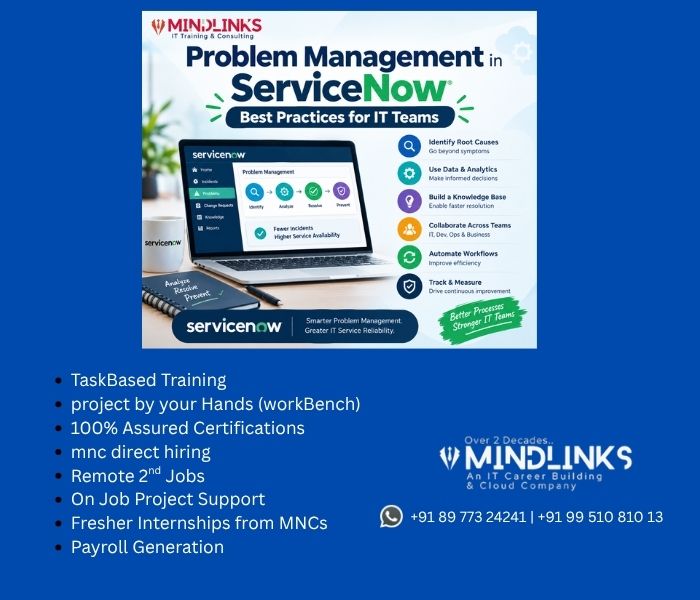
ServiceNow Problem Management: Best Practices, Processes & ITSM Strategies for Modern IT Teams
ServiceNow Problem Management plays an important role. As a core component of IT Service Management (ITSM), Problem Management helps organizations identify the underlying causes of incidents, investigate recurring issues, document known errors, and implement long-term solutions.
ServiceNow Problem Management provides IT teams with a structured approach to managing problems throughout their lifecycle. By connecting incidents, problems, changes, knowledge articles, configuration items, and service information, ServiceNow helps organizations move from reactive incident resolution toward proactive IT operations. For professionals learning ServiceNow Administration, ServiceNow ITSM, ServiceNow Developer, or ServiceNow Operations, understanding Problem Management is an important skill.
What Is Problem Management in ServiceNow?
Problem Management in ServiceNow is the process of identifying and managing the root cause of one or more incidents. While Incident Management focuses on restoring normal service as quickly as possible, Problem Management focuses on determining why an incident occurred and preventing similar incidents from happening again.
For example, suppose employees repeatedly experience slow access to an internal application. The Service Desk may create multiple incident records whenever users report the issue. Although each incident can be resolved individually, the recurring nature of the issue indicates that a deeper problem may exist.
An IT team can create a Problem record in ServiceNow and investigate the underlying cause. The team may discover that the application server is running with insufficient resources. A permanent solution can then be implemented through a Change Request. Once the change is successfully completed, the problem can be resolved and documented for future reference.
This connection between incidents, problems, changes, and knowledge management makes ServiceNow valuable for enterprise IT operations.
ServiceNow Problem Management Process
A well-defined ServiceNow Problem Management workflow generally begins when an organization identifies a recurring incident, major incident, trend, or potential underlying issue.
The first stage is problem identification. Problems can be identified through repeated incidents, monitoring systems, IT operations teams, service desk analysts, or proactive analysis of incident trends.
The next stage is problem investigation. IT teams collect relevant information and analyze incidents associated with the problem. They may examine affected configuration items, error messages, application logs, infrastructure information, and historical records.
The third stage is root cause analysis. The objective is to determine the actual reason behind the recurring issue rather than simply treating its symptoms.
After identifying the cause, the team may create a known error if the root cause is understood but a permanent solution has not yet been implemented. Workarounds can be documented so Service Desk teams can quickly assist users when the issue occurs again.
Finally, the organization can implement a permanent solution through ServiceNow Change Management. After validating the solution, the problem record can be closed with appropriate documentation.
Difference Between Incident Management and Problem Management
Understanding the difference between Incident Management and Problem Management in ServiceNow is essential for IT professionals.
Incident Management focuses on restoring a service as quickly as possible. For example, if a user cannot access an application, the Service Desk may troubleshoot the account, restart a service, or apply a temporary workaround.
Problem Management focuses on preventing the incident from happening again. If hundreds of similar incidents are caused by an underlying server configuration issue, the problem team investigates that cause and works toward a permanent resolution.
In simple terms:
Incident Management = Restore the service.
Problem Management = Find and eliminate the underlying cause.
Both processes work together to improve overall IT service availability, reliability, and user experience.
Root Cause Analysis in ServiceNow
Root Cause Analysis (RCA) is one of the most important activities within Problem Management. Instead of focusing only on what happened, RCA investigates why the issue occurred.
IT teams can use different analytical techniques depending on the nature of the problem. Common approaches include the 5 Whys technique, Fishbone or Ishikawa analysis, fault analysis, trend analysis, and technical investigation.
For example, an organization may experience repeated database outages. An initial investigation might show that the database server is running out of memory. Further analysis could reveal that a particular application process is consuming excessive resources. The actual root cause may therefore be an application configuration issue rather than the database itself.
Documenting the RCA in ServiceNow provides a centralized record that can be reviewed by technical teams, management, auditors, and support personnel.
Known Errors and Workarounds
A Known Error is an important concept in ServiceNow Problem Management. When the root cause of a problem is understood but a permanent fix is not yet available, IT teams can document the issue as a known error.
The record can contain information such as the symptoms, root cause, affected services, affected configuration items, and available workaround.
This information can help Service Desk analysts resolve future incidents more efficiently. Instead of repeating the entire troubleshooting process, support teams can refer to the documented workaround.
This also creates a connection between Problem Management and Knowledge Management, helping organizations build reusable technical knowledge.
Linking Incidents to Problems
One of the major advantages of ServiceNow is the ability to establish relationships between ITSM records.
Multiple incidents can be associated with a single problem when they are caused by the same underlying issue. This gives IT teams a broader view of recurring service disruptions.
For example, if 50 users report the same application error, creating a problem record and linking the relevant incidents allows the problem team to analyze the overall pattern.
This approach can support incident trend analysis, recurring incident identification, service improvement, and operational reporting.
Integration with Change Management
A permanent solution for a problem may require a change to an application, server, database, network, cloud environment, or business process.
This is why ServiceNow Problem Management and Change Management often work closely together.
Once the root cause has been identified, the problem team can request an appropriate change. The change can then follow the organization’s approval, planning, implementation, testing, and validation procedures.
For example, if a server configuration is identified as the cause of recurring application failures, a change request can be created to modify the configuration. After implementation and validation, the problem record can be updated with the resolution details.
This structured approach reduces the risk associated with implementing permanent fixes.
Best Practices for ServiceNow Problem Management
Organizations can improve their Problem Management process by following several practical best practices.
1. Focus on Root Causes
Avoid simply documenting symptoms. Problem Management should investigate the underlying technical or process-related cause of recurring incidents.
2. Use Incident Trends
Analyze incident history to identify recurring issues. A high number of similar incidents can indicate that a problem investigation is required.
3. Maintain Accurate Records
Problem records should contain clear descriptions, affected services, configuration items, investigation notes, root cause information, workarounds, and resolution details.
4. Collaborate Across IT Teams
Many problems involve multiple teams. Service Desk, Infrastructure, Network, Database, Cloud, Security, Application Development, and other teams may need to collaborate during investigation and resolution.
5. Connect Problems with Changes
When a permanent solution requires a system modification, connect the problem with the relevant Change Request. This provides better traceability.
6. Document Known Errors
Known errors and workarounds can help support teams respond faster when the same symptoms appear again.
7. Use ServiceNow Reporting and Analytics
Organizations can monitor problem trends, open problems, aging records, recurring incidents, resolution times, and other operational metrics.
8. Review Major Incidents
Major incidents should be reviewed to determine whether a related problem investigation is required. Post-incident analysis can reveal opportunities for long-term improvement.
ServiceNow Problem Management Metrics
Measuring Problem Management performance helps organizations understand whether the process is improving IT service reliability.
Useful metrics may include the number of open problems, number of recurring incidents, problem resolution time, average problem age, number of known errors, number of successfully implemented permanent fixes, and incidents associated with known problems.
Organizations can also analyze trends over time to determine whether recurring incidents are decreasing.
These metrics can support ITSM reporting, service improvement initiatives, operational dashboards, and management decision-making.
Role of Automation in ServiceNow Problem Management
Automation is increasingly important in modern IT operations. ServiceNow provides workflow and automation capabilities that can help streamline ITSM processes.
Organizations can configure workflows to assign tasks, notify responsible teams, update records, trigger approvals, and connect related activities.
When Problem Management is integrated with other ServiceNow applications, IT teams can create a more connected operational environment.
For professionals learning ServiceNow Administration, understanding tables, forms, workflows, business rules, notifications, reports, ACLs, and integrations can help them understand how Problem Management is implemented within the ServiceNow platform.
Why Learn ServiceNow Problem Management?
ServiceNow skills are relevant across several IT roles, including ServiceNow Administrator, ServiceNow Developer, ITSM Consultant, Service Desk Analyst, IT Operations Professional, Business Analyst, and ServiceNow Implementation Consultant.
Learning Problem Management gives professionals practical knowledge of how organizations manage recurring IT issues and improve service reliability.
A strong ServiceNow learning path should cover not only Problem Management but also Incident Management, Change Management, Service Request Management, Knowledge Management, Service Catalog, CMDB, ITSM workflows, reporting, automation, and integrations.
Learn ServiceNow with MiNdLiNkS
MiNdLiNkS provides ServiceNow training in Hyderabad designed to help learners build practical knowledge of ServiceNow ITSM and enterprise service management. Training can cover important areas such as ServiceNow Administration, ServiceNow Developer concepts, Incident Management, Problem Management, Change Management, Service Catalog, CMDB, workflows, automation, reporting, and real-time project scenarios.
For freshers and working IT professionals, practical exposure can help connect theoretical ServiceNow concepts with real-world IT operations. Learners can explore how incidents are created and managed, how recurring incidents are converted into problems, how root cause analysis is performed, how known errors are documented, and how permanent fixes can be implemented through Change Management.
MiNdLiNkS also focuses on job-oriented IT training, real-time project exposure, ServiceNow career preparation, interview preparation, and placement support, helping learners develop skills relevant to modern IT service management environments.
Conclusion
ServiceNow Problem Management provides organizations with a structured method for identifying recurring issues, performing root cause analysis, managing known errors, and implementing permanent solutions. When integrated with Incident Management, Change Management, Knowledge Management, CMDB, and ITSM workflows, it can help IT teams move beyond short-term incident resolution toward proactive service improvement.
For IT professionals, learning ServiceNow Problem Management best practices is an important part of understanding enterprise ITSM. Whether you are preparing for a ServiceNow Administrator, ServiceNow Developer, ITSM Consultant, or ServiceNow support role, knowledge of problem identification, RCA, known errors, workflows, reporting, and change integration can strengthen your practical ServiceNow skill set.
With structured learning and real-time project exposure from MiNdLiNkS, learners can develop practical knowledge of ServiceNow ITSM processes and explore how organizations use the platform to manage incidents, problems, changes, services, and IT operations efficiently.