
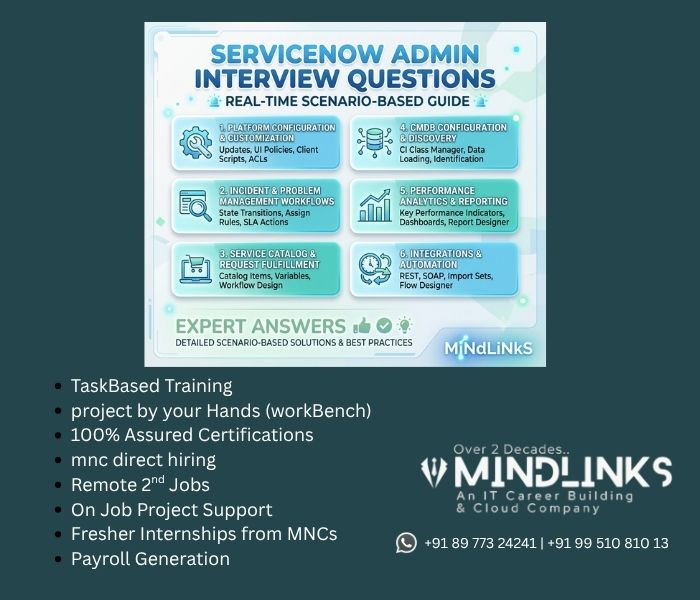
ServiceNow Admin Interview Questions with Expert Answers | MiNdLiNkS
Preparing for a ServiceNow Administrator interview? This scenario-based interview guide from MiNdLiNkS IT Consulting covers real-time ServiceNow administration challenges, troubleshooting techniques, and practical solutions frequently discussed in IT interviews. These questions help freshers and experienced professionals strengthen their knowledge of ServiceNow ITSM, ACLs, Business Rules, Client Scripts, UI Policies, Flow Designer, Incident Management, Change Management, Service Catalog, CMDB, and data imports.
1. A User Cannot Access an Incident Record. How Would You Troubleshoot It?
Scenario: One user can view an Incident, but another user receives an access-denied message.
Expert Answer: I would compare user roles, group memberships, and access permissions. Next, I would examine table-level, field-level, and record-level Access Control Lists (ACLs), including role requirements and scripted conditions. I would use Debug Security Rules to identify the rule denying access. After identifying the root cause, I would implement the required permission change following security guidelines and test it with the affected user.
2. An Incident Is Assigned to the Wrong Assignment Group. What Would You Check?
Scenario: Newly created Incidents are automatically assigned to an incorrect support group.
Expert Answer: I would investigate Assignment Rules, Business Rules, Flow Designer flows, data lookup rules, and other assignment automation. I would reproduce the issue, review execution details, and identify which process updates the Assignment Group field. I would correct the responsible configuration and validate the solution in a non-production instance before deployment.
3. A Business Rule Is Making Incident Updates Slow. How Would You Fix It?
Scenario: Users experience delays when creating or updating Incident records.
Expert Answer: I would inspect the Business Rule execution timing, conditions, GlideRecord queries, loops, and related scripts. I would review system logs and transaction diagnostics to identify inefficient operations. Depending on the requirement, I would optimize the query, avoid unnecessary database calls, and consider asynchronous processing where appropriate. I would then test performance and ensure that existing business logic remains correct.
4. How Would You Make a Field Mandatory Only for Critical Incidents?
Scenario: A resolution-related field must become mandatory when an Incident meets a specified priority condition.
Expert Answer: I would evaluate whether a UI Policy can handle the requirement without scripting. I would configure the appropriate condition and make the field mandatory when it matches. If the rule must also be enforced for integrations, imports, or server-side updates, I would implement suitable server-side validation because a UI Policy alone does not enforce the requirement across every entry point.
5. A Flow Designer Flow Creates Duplicate Records. How Would You Resolve It?
Scenario: Updating a record triggers a flow repeatedly, creating duplicate task records.
Expert Answer: I would inspect Flow Designer execution details, trigger conditions, record updates, loops, and retry behavior. I would determine whether the flow’s own updates cause it to trigger again. I would refine the trigger conditions, introduce appropriate duplicate-prevention checks, and use a reliable record identifier where applicable. I would test repeated updates and retries before deploying the correction.
6. Users Are Not Receiving Approval Emails. What Would You Investigate?
Scenario: Approval records exist, but managers do not receive notification emails.
Expert Answer: I would verify the approval records, approver configuration, manager relationship, notification conditions, event generation, and recipient details. I would then examine email logs and System Mailboxes to determine whether the email was generated, queued, sent, or rejected. I would also verify that the instance’s email configuration permits outbound messages.
7. A Data Import Creates Duplicate User Records. What Is the Likely Cause?
Scenario: An Import Set creates new users instead of updating existing user records.
Expert Answer: I would review the Transform Map and its coalesce configuration. Coalescing allows ServiceNow to identify matching records and update them instead of creating duplicates. I would select an appropriate unique identifier, test the transformation with sample data, review transform errors, and establish a controlled process to resolve existing duplicates.
8. A Service Catalog Item Works for Administrators but Fails for Normal Users. How Would You Troubleshoot It?
Scenario: Administrators can submit a Catalog Item, but other users cannot access or submit it.
Expert Answer: I would compare roles and permissions, inspect Catalog Item availability and User Criteria, and check Catalog Client Scripts, UI Policies, variables, ACLs, and Flow Designer execution. I would reproduce the issue using an affected user’s access context and review error logs. I would then address the specific access or configuration issue rather than granting unnecessary administrator privileges.
9. An SLA Is Not Attaching to an Incident. What Would You Check?
Scenario: An Incident meets the expected criteria, but the required SLA does not appear.
Expert Answer: I would review the SLA Definition, target table, start conditions, stop conditions, pause conditions, schedule, and active status. I would inspect the Task SLA records and confirm that the Incident meets the start conditions at the appropriate time. I would also check whether the schedule and priority conditions are configured correctly.
10. A Business Rule Works in Development but Fails in Production. Why?
Scenario: A customization behaves correctly in the development instance but does not work after deployment.
Expert Answer: I would compare the environments for missing dependencies, system properties, plugins, application scopes, ACLs, Script Includes, reference data, and integration configuration. I would review the deployed Update Set and relevant logs to identify differences. After correcting the missing configuration or dependency, I would test the change using the organization’s deployment and change-management process.
Why Learn ServiceNow Administration with MiNdLiNkS?
MiNdLiNkS IT Consulting provides IT training focused on practical concepts, configuration knowledge, troubleshooting, and interview preparation. Learners can strengthen their understanding of ServiceNow administration, ITSM processes, automation, access control, and real-time project scenarios.
Explore the following resources:
- ServiceNow Online Training in Hyderabad: https://www.themindlinks.com/job/servicenow-online-training-in-hyderabad/
Whether you are a fresher preparing for your first IT job or an experienced professional seeking to improve your ServiceNow administration skills, practicing scenario-based questions can help you explain your troubleshooting approach clearly during interviews.