
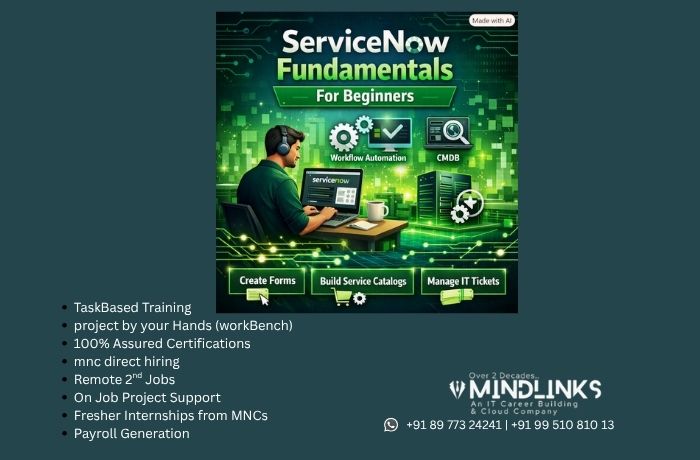
ServiceNow Fundamentals Every Beginner Should Learn
ServiceNow has become one of the most widely used cloud-based platforms for managing IT services, business processes, workflows, and enterprise operations. For beginners planning to build a career in the IT industry, learning ServiceNow fundamentals can be an excellent starting point because the platform is used by organizations across different industries to automate processes, manage incidents, improve employee experiences, and streamline business operations. Whether you are a fresher, an IT professional, a system administrator, a developer, or someone planning a career transition, understanding the basics of ServiceNow can help you develop practical skills that are relevant to modern enterprise environments. MiNdLiNkS provides job-oriented ServiceNow training designed to help learners understand the platform from fundamentals to practical implementation while preparing them for real-world IT career opportunities.
What Is ServiceNow?
ServiceNow is a cloud-based digital workflow platform that helps organizations automate and manage different business and IT processes from a centralized environment. It is widely associated with IT Service Management (ITSM), including incident management, problem management, change management, service request management, and knowledge management. However, ServiceNow has expanded beyond traditional IT service management and now supports areas such as IT Operations Management, IT Asset Management, Customer Service Management, Security Operations, Human Resources Service Delivery, Governance, Risk and Compliance, and more. For a beginner, understanding this broader ServiceNow ecosystem is important because it helps explain why ServiceNow professionals are increasingly required in enterprise IT environments.
Why Should Beginners Learn ServiceNow?
Learning ServiceNow can provide a strong foundation for developing a career in enterprise IT. Organizations need professionals who can configure workflows, manage applications, automate repetitive tasks, develop custom solutions, and maintain ServiceNow environments. A beginner who learns ServiceNow fundamentals can gradually progress into roles such as ServiceNow Administrator, ServiceNow Developer, ServiceNow Consultant, ServiceNow ITSM Specialist, ServiceNow Business Analyst, and other specialized positions. Instead of learning only theoretical concepts, beginners should focus on understanding how the platform solves actual business problems. This is why job-oriented ServiceNow training with practical examples, projects, workflow exercises, and interview preparation can be valuable for students and professionals.
Understanding the ServiceNow Platform
The first fundamental concept every beginner should understand is the ServiceNow platform itself. ServiceNow provides a centralized environment where organizations can create applications, manage records, automate workflows, assign tasks, and monitor processes. The platform uses a structured data model in which information is stored in tables and accessed through applications and modules. Beginners should become familiar with the ServiceNow interface, application navigator, lists, forms, records, dashboards, filters, reports, and system settings. These concepts may appear simple, but they form the foundation for almost every ServiceNow administration and development activity.
ServiceNow Tables, Records and Fields
Tables are an important part of ServiceNow fundamentals. A table stores information related to a particular type of record. For example, incident records are stored in the Incident table, while user information is maintained in the User table. Each record contains different fields that store specific information. Beginners should understand how tables, records, fields, reference fields, choice fields, and relationships work. Learning these concepts makes it easier to understand how data moves through ServiceNow applications. A strong understanding of the ServiceNow data model is particularly useful for professionals interested in ServiceNow administration and development.
ServiceNow Incident Management
Incident Management is one of the most important topics for beginners learning ServiceNow. An incident generally represents an unplanned interruption or reduction in the quality of an IT service. ServiceNow provides a structured process for creating, assigning, prioritizing, updating, resolving, and closing incidents. Beginners should learn concepts such as incident categories, assignment groups, priority, impact, urgency, SLAs, incident states, resolution codes, and notifications. Understanding the complete incident lifecycle helps learners see how ServiceNow supports IT support teams and improves service delivery.
Problem Management
Problem Management focuses on identifying and addressing the underlying causes of recurring incidents. While Incident Management focuses on restoring normal service as quickly as possible, Problem Management aims to prevent similar incidents from happening repeatedly. Beginners should understand the difference between an incident and a problem and learn how problems, root-cause analysis, known errors, and corrective actions are managed in ServiceNow. This knowledge is useful for anyone preparing for ServiceNow ITSM jobs because ITSM professionals are expected to understand how different processes work together.
Change Management
Change Management is another essential ServiceNow concept. Organizations frequently need to modify applications, infrastructure, configurations, or IT services. Changes must be planned, assessed, approved, implemented, and reviewed carefully to reduce business risks. ServiceNow helps organizations manage these activities through structured workflows. Beginners should understand normal changes, standard changes, emergency changes, approvals, risk assessment, implementation plans, testing, and change closure. Learning Change Management provides valuable knowledge about how enterprise IT environments control modifications.
Service Catalog and Request Management
The Service Catalog allows employees and customers to request services through a structured interface. For example, an employee may request access to an application, a laptop, software installation, or another IT service. Beginners should understand catalog items, variables, variable sets, request records, approvals, fulfillment processes, and workflows. Learning the Service Catalog is particularly important for aspiring ServiceNow developers and administrators because organizations frequently customize catalog experiences according to their business requirements.
ServiceNow Users, Groups and Roles
Access control is another fundamental area of ServiceNow. Beginners should learn about users, groups, roles, and permissions. Users represent individuals who access the platform, groups help organize users and assignment responsibilities, and roles determine what users can access or perform. Understanding roles and access control is essential for maintaining platform security. Concepts such as Access Control Lists, or ACLs, should also be introduced at the beginner level because security is an important part of ServiceNow administration.
Workflows and Automation
One of ServiceNow’s major advantages is its ability to automate business processes. Beginners should understand how workflows and automation help organizations reduce manual work. A workflow can automatically assign tasks, request approvals, send notifications, update records, and move a process from one stage to another. Modern ServiceNow environments also use Flow Designer and other automation capabilities to build efficient workflows. Learning workflow automation can help beginners understand how ServiceNow is used not simply as a ticketing system but as an enterprise automation platform.
Business Rules and Client Scripts
For learners interested in ServiceNow development, Business Rules and Client Scripts are important concepts. Business Rules execute server-side logic when specific database operations occur, while Client Scripts are generally used to control behavior on forms in the user’s browser. Beginners should understand when these features are appropriate and how they affect ServiceNow records and user interactions. They should also learn the importance of writing efficient scripts and avoiding unnecessary customization. Good ServiceNow development focuses on solving business requirements while maintaining platform performance and upgrade compatibility.
UI Policies and Data Validation
UI Policies allow administrators to dynamically control form behavior based on conditions. They can make fields mandatory, visible, or read-only depending on specific requirements. Data validation is equally important because accurate information is necessary for reporting, automation, and service management. Beginners should practice creating simple conditions and understanding how different configuration features interact. These skills are commonly included in ServiceNow administrator training programs.
Notifications and Email Management
ServiceNow can automatically notify users when important events occur. Notifications may be triggered when an incident is created, assigned, updated, resolved, or when an approval is required. Beginners should understand notification conditions, recipients, email templates, and event-driven communication. Effective notifications help IT teams respond quickly and keep users informed throughout a service request or incident lifecycle.
Reports and Dashboards
Organizations need accurate information to monitor service performance and make business decisions. ServiceNow provides reporting and dashboard capabilities that allow teams to visualize data and track key metrics. Beginners should learn how to create basic reports, apply filters, group records, and understand common reporting requirements. Dashboards can provide a consolidated view of incidents, requests, SLA performance, assignments, and other operational information. These skills can become valuable when preparing for a ServiceNow administrator interview.
ServiceNow Scripting and JavaScript Basics
Beginners interested in becoming ServiceNow developers should learn basic JavaScript concepts. ServiceNow uses JavaScript extensively for server-side and client-side customization. Understanding variables, functions, conditions, arrays, objects, loops, and basic scripting logic can make advanced ServiceNow topics easier to understand. However, beginners should first focus on platform concepts before attempting complex scripts. A combination of ServiceNow knowledge and JavaScript skills can provide a strong foundation for ServiceNow developer training.
Practical Projects and Real-Time Learning
The best way to understand ServiceNow fundamentals is through hands-on practice. Instead of only reading about Incident Management, a learner can create incidents, assign them to groups, update priorities, configure SLAs, resolve incidents, and generate reports. Similarly, learners can build a simple Service Catalog item, create an approval workflow, configure notifications, and automate task assignments. MiNdLiNkS focuses on practical and job-oriented learning approaches that can help students understand how ServiceNow concepts are applied in real-world IT environments. Real-time project exposure can also help learners become more confident when explaining ServiceNow workflows and configurations during interviews.
ServiceNow Certification and Career Preparation
Certification can help learners demonstrate their understanding of the ServiceNow platform. Beginners can explore appropriate ServiceNow certification paths after developing a solid understanding of the fundamentals. However, certification alone should not be the only goal. Employers also value practical knowledge, troubleshooting ability, configuration experience, communication skills, and the ability to understand business requirements. A well-structured ServiceNow training program can combine technical learning with project experience, interview preparation, resume guidance, and career support.
How MiNdLiNkS Helps Beginners Learn ServiceNow
MiNdLiNkS helps learners approach ServiceNow through a structured, career-focused learning path. Instead of limiting training to theoretical explanations, the focus can be placed on understanding ServiceNow applications, ITSM processes, administration concepts, configuration, workflows, scripting fundamentals, reporting, and practical project scenarios. Learners can strengthen their technical knowledge through guided exercises and real-time project-oriented learning. MiNdLiNkS also supports learners with job-oriented IT training, interview preparation, resume guidance, certification guidance, and placement assistance, helping them prepare for the transition from training to professional opportunities.
Conclusion
Learning ServiceNow fundamentals is an excellent starting point for anyone interested in building a career around enterprise IT service management and workflow automation. Beginners should gradually develop knowledge of the ServiceNow interface, tables, records, Incident Management, Problem Management, Change Management, Service Catalog, users and roles, ACLs, workflows, Flow Designer, Business Rules, Client Scripts, notifications, reports, dashboards, and JavaScript fundamentals. Once these concepts are understood, learners can progress toward advanced administration, development, ITSM implementation, consulting, and specialized ServiceNow career paths.
With the growing adoption of enterprise workflow automation, developing practical ServiceNow skills can open opportunities for freshers and experienced IT professionals. Choosing a structured ServiceNow training program in Hyderabad with practical learning, real-time project exposure, certification guidance, and placement support can make the learning journey more career-focused. MiNdLiNkS aims to bridge the gap between technical training and industry requirements by helping learners build practical IT skills and prepare for ServiceNow career opportunities.
Popular Keywords: ServiceNow Training, ServiceNow Training in Hyderabad, ServiceNow Online Training, ServiceNow ITSM Training, ServiceNow Administrator Training, ServiceNow Developer Training, ServiceNow Certification Training, ServiceNow Course, ServiceNow Jobs, ServiceNow Interview Preparation, Job-Oriented IT Training, IT Training Institute in Hyderabad, ServiceNow Career, ServiceNow Real-Time Projects, ServiceNow Placement Assistance.