
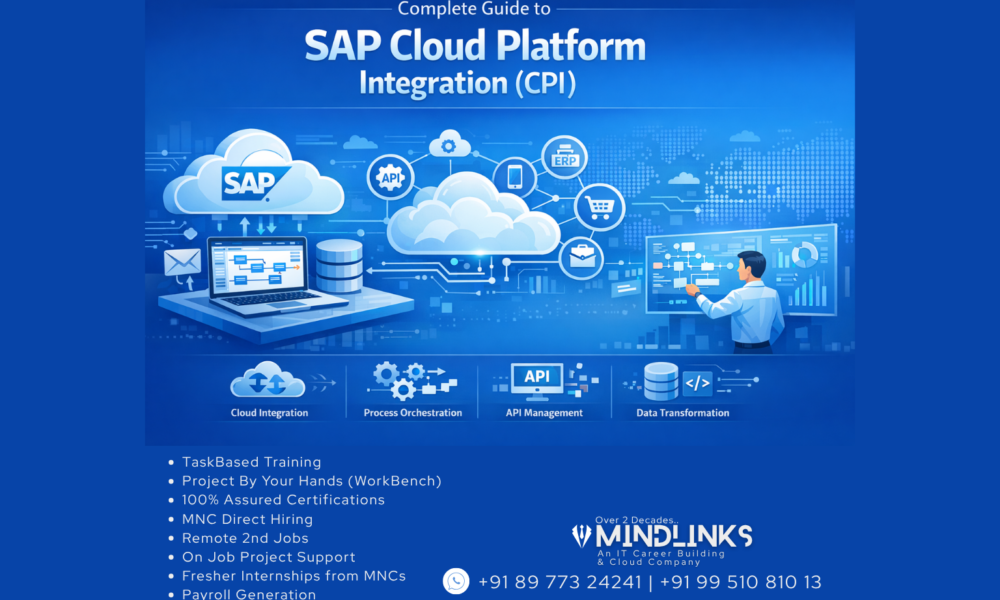
Complete Guide to SAP Cloud Platform Integration (CPI)
For More Job Updates and Placements info join this Whatsapp Channel: https://whatsapp.com/channel/0029Va85cqaBadmfJ9fYTw3c
In today’s rapidly evolving digital landscape, organizations are increasingly adopting cloud technologies to enhance efficiency, scalability, and performance. However, as businesses move towards multiple cloud applications and hybrid environments, integrating these systems becomes a major challenge. This is where Cloud CPI (SAP Cloud Platform Integration) plays a crucial role.
Cloud CPI is a powerful integration platform that enables seamless communication between various systems, whether they are on-premise or cloud-based. It ensures smooth data exchange and process automation across different business applications.
MiNdLiNkS offers industry-focused Cloud CPI training that equips learners with real-time skills, helping them become job-ready professionals in the SAP integration domain.
What is SAP Cloud Platform Integration (CPI)
SAP Cloud Platform Integration, commonly known as CPI, is a cloud-based middleware solution provided by SAP. It is part of the SAP Integration Suite and is designed to simplify the integration of diverse systems and applications.
CPI enables organizations to connect:
- SAP systems with other SAP systems
- SAP systems with non-SAP applications
- Cloud applications with on-premise systems
- Third-party platforms and services
The platform provides pre-built integration content, adapters, and tools that help developers design, execute, and monitor integration flows efficiently.
With MiNdLiNkS training, learners gain hands-on experience in building and managing integration scenarios using SAP CPI.
Why Cloud CPI is Important in Modern Businesses
As companies adopt multiple digital tools, data is often spread across different systems. Without proper integration, this leads to inefficiencies, data silos, and operational delays.
Cloud CPI solves these challenges by providing a unified integration platform.
Key Importance of Cloud CPI
First, it ensures real-time data synchronization between systems, enabling businesses to make faster and more accurate decisions.
Second, it reduces manual intervention by automating workflows, which improves productivity and reduces errors.
Third, it supports scalability, allowing businesses to expand their operations without worrying about integration limitations.
Fourth, it enhances security by providing built-in authentication and encryption mechanisms.
At MiNdLiNkS, learners understand these real-world challenges and learn how CPI helps organizations overcome them.
Key Features of Cloud CPI
Cloud CPI comes with a wide range of features that make it one of the most preferred integration platforms.
Pre-Built Integration Content
SAP provides ready-to-use integration packages that include predefined integration flows. These packages help reduce development time and accelerate implementation.
Multiple Adapters
CPI supports various adapters that enable communication between systems. Some commonly used adapters include HTTP, SOAP, REST, IDoc, SFTP, and OData.
Message Mapping and Transformation
CPI allows data transformation between different formats such as XML, JSON, and CSV. This ensures compatibility between systems with different data structures.
Real-Time Monitoring
The platform provides monitoring tools that allow users to track integration processes, identify errors, and resolve issues quickly.
Secure Connectivity
CPI ensures secure communication through encryption, authentication, and role-based access control.
MiNdLiNkS training covers all these features with practical demonstrations and real-time examples.
Architecture of Cloud CPI
Understanding the architecture of Cloud CPI is essential for mastering integration concepts.
Tenant
A tenant is a dedicated environment where integration processes are designed and executed. Each organization gets its own tenant.
Integration Flows (iFlows)
Integration flows define the logic of how data moves from the source system to the target system. They include routing, transformation, and processing steps.
Adapters
Adapters act as connectors between different systems. They enable communication by supporting various protocols.
Message Processing Engine
This component processes incoming messages, applies transformations, and routes them to the appropriate destination.
Security Layer
CPI includes a security framework that ensures safe data transmission through authentication and encryption.
At MiNdLiNkS, learners gain hands-on experience in designing and deploying iFlows within this architecture.
How Cloud CPI Works
The working of Cloud CPI involves several steps:
First, data is generated from a source system such as an ERP or CRM application.
Next, the data is sent to CPI through a specific adapter.
Then, CPI processes the data by applying transformations and business logic defined in the integration flow.
After processing, the data is routed to the target system.
Finally, the monitoring tools track the entire process and provide logs for analysis.
This structured approach ensures reliable and efficient data integration across systems.
Real-Time Use Cases of Cloud CPI
Cloud CPI is widely used across industries for various integration scenarios.
HR System Integration
Organizations use CPI to integrate SAP SuccessFactors with other HR systems. This helps in synchronizing employee data, payroll, and performance records.
E-Commerce Integration
CPI connects SAP systems with e-commerce platforms to manage orders, inventory, and customer data efficiently.
Finance and Accounting Integration
Businesses use CPI to automate financial processes such as invoicing, billing, and payment processing.
Supply Chain Integration
CPI enables seamless communication between suppliers, manufacturers, and distributors, improving supply chain efficiency.
MiNdLiNkS provides real-time project exposure to help learners understand these use cases in depth.
Cloud CPI vs Traditional Middleware
Cloud CPI offers several advantages over traditional middleware solutions.
Cloud CPI is cloud-based, which eliminates the need for physical infrastructure. It provides high scalability, allowing businesses to handle increasing workloads بسهولة.
In contrast, traditional middleware requires on-premise infrastructure, which increases maintenance costs and limits scalability.
Cloud CPI also offers faster deployment and easier updates, making it more suitable for modern business environments.
Career Opportunities in Cloud CPI
With the growing adoption of cloud technologies, the demand for SAP CPI professionals is increasing rapidly.
Job Roles
- SAP CPI Consultant
- Integration Developer
- Middleware Architect
- SAP Integration Specialist
Skills Required
- Understanding of integration concepts
- Knowledge of XML, JSON, and APIs
- Familiarity with SAP systems
- Experience with cloud technologies
MiNdLiNkS helps learners build these skills through structured training programs and real-time projects.
Why Choose MiNdLiNkS for Cloud CPI Training
Choosing the right training institute plays a crucial role in your career success.
MiNdLiNkS stands out due to its practical approach to learning.
Key Advantages
- Real-time project-based training
- Experienced industry professionals as trainers
- Hands-on practice with live scenarios
- Interview preparation and resume building
- Placement assistance
The training program is designed to bridge the gap between theoretical knowledge and practical implementation.
Step-by-Step Guide to Learning Cloud CPI
Learning Cloud CPI requires a structured approach.
Step 1: Learn Integration Basics
Understand the fundamentals of system integration and data exchange.
Step 2: Understand CPI Architecture
Learn about tenants, iFlows, adapters, and message processing.
Step 3: Practice Integration Flows
Create and deploy iFlows to gain hands-on experience.
Step 4: Work on Real-Time Projects
Apply your knowledge to real-world scenarios.
Step 5: Prepare for Certification
Get certified to validate your skills and improve job opportunities.
MiNdLiNkS provides complete guidance throughout this learning journey.
Common Challenges in Cloud CPI and How to Overcome Them
While learning CPI, beginners may face certain challenges.
One common issue is understanding complex integration scenarios. This can be overcome through consistent practice and real-time examples.
Another challenge is working with message mappings. Learning data transformation techniques helps simplify this process.
Debugging errors can also be difficult initially, but using monitoring tools and logs makes it easier.
MiNdLiNkS training focuses on solving these challenges with practical sessions and expert guidance.
Future Scope of Cloud CPI
The future of Cloud CPI looks promising as more organizations move towards cloud-based systems.
Integration platforms are becoming essential for digital transformation, and SAP CPI is one of the leading tools in this space.
Professionals with CPI expertise can expect excellent career growth, high salaries, and global job opportunities.
Conclusion
Cloud CPI is a powerful and essential tool for modern businesses that rely on multiple systems and applications. It simplifies integration, improves efficiency, and supports digital transformation.
With increasing demand for SAP integration professionals, learning Cloud CPI is a smart career choice.
MiNdLiNkS provides comprehensive training that combines theoretical knowledge with real-time practical experience, helping learners achieve their career goals.